
We check a simulation model at rest before we trust it for analysis or policy testing. This note walks through the method with a small SaaS pipeline, for modellers who want a yes/no quality test.
TL;DR
We trust a model for analysis and policy testing only after it passes a quality check at rest. We start it in equilibrium, confirm it stays there, confirm that nothing is created or lost, and confirm it responds in a way we can defend when we change it. A model that drifts with no input has a structural or initialisation problem, and we want to find it before anyone sees a result.
- A units check proves the equations balance dimensionally. An equilibrium check proves the model behaves consistently.
- Run both before any analysis or policy test.
// The example
A three-stock SaaS pipeline is enough to test the method
New trials enter the pipeline, move through onboarding and end up as active customers in operations. The model has three stocks and these parameters:
- 100 new trials start per week.
- Trial lasts 2 weeks. 40% move on to onboarding, 60% leave.
- Onboarding lasts 3 weeks. 90% move on to operations, 10% leave.
- Customers in operations churn at 2% per week.
// Equilibrium
In equilibrium, every stock has inflow equal to outflow
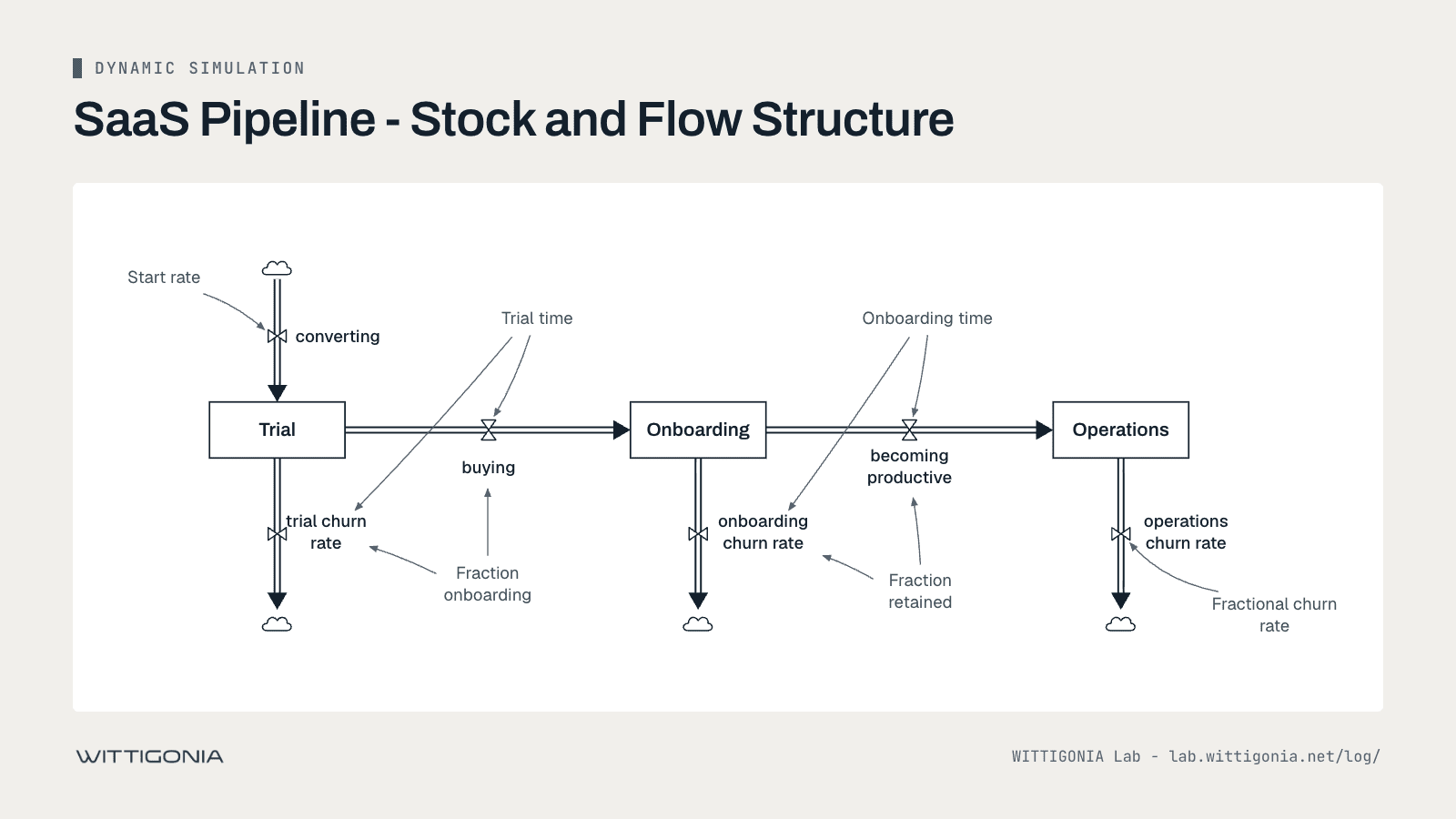
For a pipeline stage, the starting value is throughput multiplied by the average time an item spends in the stage. For a stock that only loses items at a fractional rate, it is inflow divided by that rate. We use this as a check, not as a rule for every model: it is how we assure quality before a model is trusted for analysis.
// Consistency
Consistency: a balanced model stays flat
In our pipeline, the equilibrium stocks are:
- Trial: 100 per week x 2 weeks = 200 customers.
- Onboarding: 40 per week x 3 weeks = 120 customers.
- Operations: 36 per week / 0.02 per week = 1,800 customers.
All three lines must run flat. If a stock moves before we apply any shock, something is wrong. Typical causes are a missing or mis-wired flow, or initial values that do not match the equations. The check turns "does this look right?" into a yes/no test.
The distribution also tells a story. 1,800 of the 2,120 customers sit in operations, and only 200 in trial. If that picture looked implausible against the real business, we would revisit structure or parameters first.
| Check | What it tests | Typical failure it finds |
|---|---|---|
| Units check | Dimensional consistency: does every equation balance in its units, such as customers per week integrating into customers? | An equation whose units do not balance |
| Equilibrium check | Behavioural consistency: does the model stay at rest when nothing is changed? | A stock that drifts because of a wrong initial value or a missing flow |
Vensim reports a passing units check as "Units are AOK" (source 1). Units errors do not prevent a simulation (source 2), and a model can pass the units check and still be wrong.
// Conservation
Conservation: what flows in must flow out or stay in
There is no magic loss or gain of people. In our pipeline, 100 trials per week come in. Out go 60 lost in trial, 4 lost in onboarding and 36 churned from operations, which is also 100. At any time, initial total + cumulative inflow - cumulative outflow = sum of all stocks.
We also test whether the model stays balanced when its structure changes. We add an outflow: involuntary churn of 0.5% per week on top of the existing 2%. The operations equilibrium becomes 36 / 0.025 = 1,440. If the initial value is derived from the equations, the model starts at 1,440 and stays flat. If the old value of 1,800 was hard-coded, the stock slides down to 1,440 on its own. That slide looks like business behaviour, but it is a modelling artefact, and exactly the kind of error that damages trust later.
// Credibility
Credibility: the response must be one we can defend
Only now do we trigger the system. We raise trial starts by 10%, from 100 to 110 per week, and change nothing else. Trial and onboarding settle within weeks. Operations needs well over a year to reach its new level of 1,980, because the 2% churn gives that stock a time constant of 50 weeks. That slow tail is the model's own dynamics. It is not mixed up with a startup transient, so it can be read and explained.
We then move churn from the balanced state to 4%, then to 20%. The operations stock falls to 900, then to 180, following inflow divided by churn. We check that the response is proportional where the structure says it should be, that no stock goes negative, and that the numerics stay stable. We only see this non-linear response clearly because we started in balance.
A model that passes these checks is easier to believe and easier to use. When a stakeholder changes churn in a workshop, they see a response they can explain, not an unexplained line moving.
// Policy test
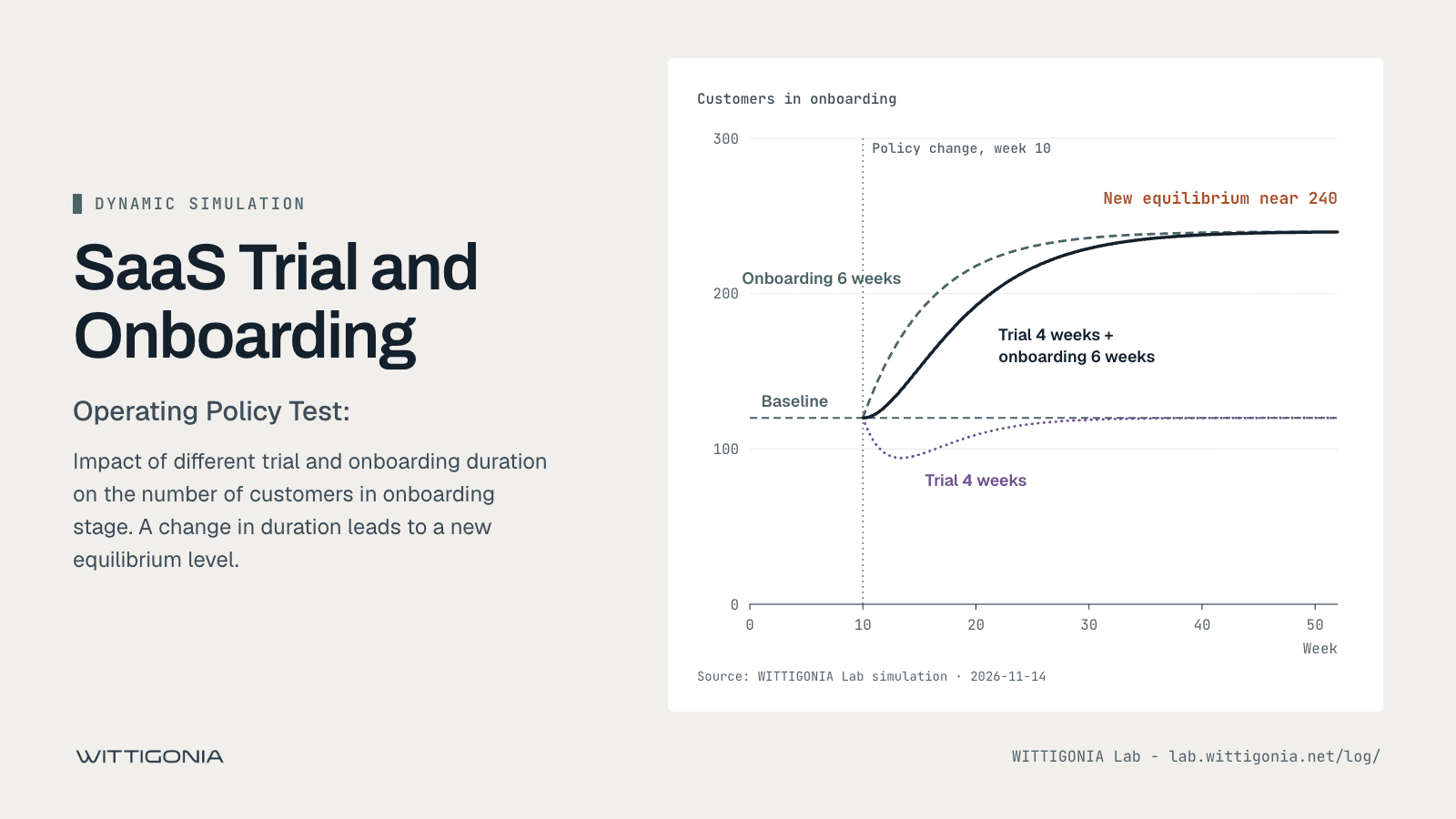
Policy test: onboarding time moves the level, trial time only delays it
With the balanced model we can test operating policies. The question: how do different trial and onboarding durations change the number of customers in onboarding?
Try it yourself: the model below uses the same parameters as the example in this note. Change a setting and watch how the pipeline responds.
Chart of a business in balance: 200 customers in trial, 120 in onboarding and 1,800 in operation, unchanged for two years. Open the full model
Interactive model: SaaS journey v1.0 by WITTIGONIA Dynamics (Thomas Wittig), © 2026 WITTIGONIA. Compiled with SDEverywhere by Climate Interactive (MIT licence); authored in Vensim by Ventana Systems. All credits, licences and how to cite.
Onboarding stock equals throughput times duration, so doubling onboarding from 3 to 6 weeks doubles the stock. A longer trial delays arrivals once, then the same 40 customers per week arrive again.
Only a model that passes both the units check and the equilibrium check goes on to analysis and policy testing.
// FAQ
Frequently asked questions
What is an equilibrium check for a simulation model?
It is a test at rest. Every stock starts at a value where inflow equals outflow, and we confirm the model stays flat until we change something. Drift without input points to a structural or initialisation problem.
How do you calculate the equilibrium value of a stock?
For a pipeline stage, multiply throughput by the average time an item spends in it: 40 customers per week x 3 weeks = 120. For a stock that loses a fixed fraction per week, divide inflow by that fraction: 36 per week / 0.02 per week = 1,800.
What is the difference between a units check and an equilibrium check?
A units check tests whether every equation balances dimensionally. Vensim reports a pass as "Units are AOK" (source 1), and units errors do not prevent a simulation (source 2). A model with correct units can still drift because of a wrong initial value or a missing flow, and the equilibrium check finds that drift.
// Sources
Sources
- Vensim Help: Checking for Model Syntax and Units Errorsaccessed 2026-11-15
- Vensim Help: Units Checkaccessed 2026-11-15