
Why we built this stack on Zoho Sites (vs. WordPress)
The Lab is our "Clean Room." It is where we isolate variables to test new marketing and sales strategies before deploying them to the main wittigonia.net brand. For this specific environment, we made a deliberate choice to move away from the industry standard (WordPress) and deploy on Zoho Sites.
Here is the architectural breakdown of the lab. stack, the privacy governance logic, and the data flow behind the scenes.
// The Rationale
Integration over Plugins.
In the WordPress ecosystem, connecting a frontend form to a backend CRM usually requires a plugin (Gravity Forms, FluentForms, Thrive Leads), a connector (Zapier), and a destination (Salesforce/HubSpot). That is three points of failure and it adds to the cost-of-ownership of running and maintaining this tech stack.
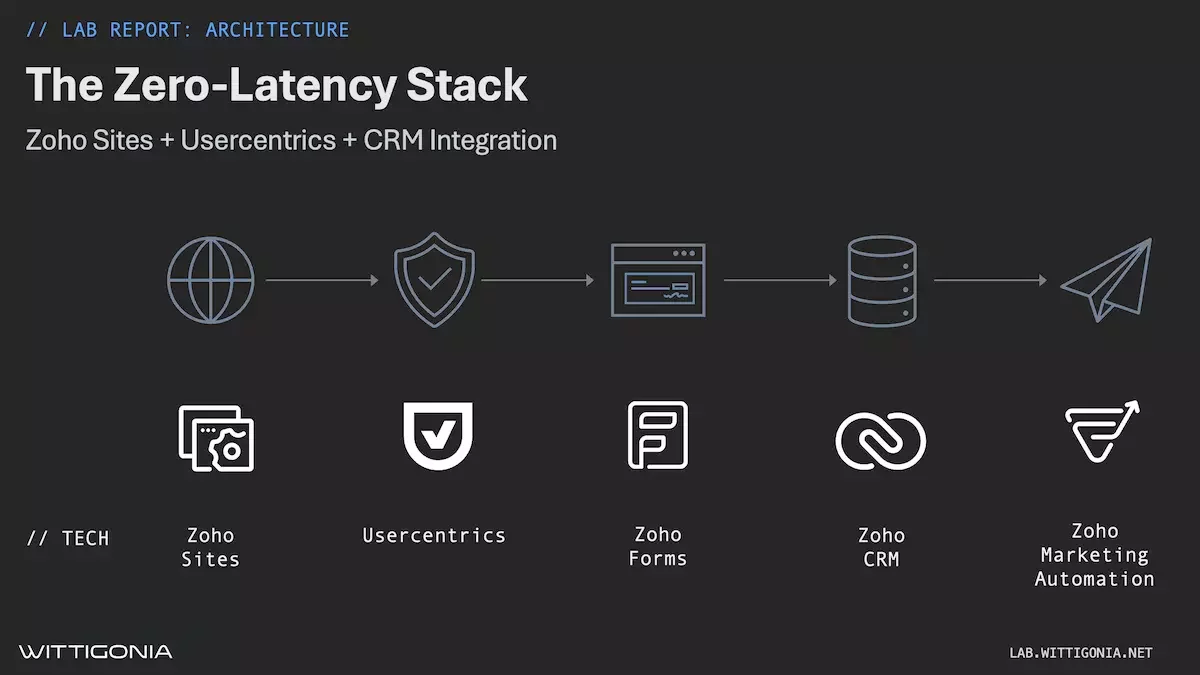
On this site, we are testing a "Zero-Latency" stack:
Host: Zoho Sites
Input: Zoho Forms (Embedded)
Database: Zoho CRM
Automation: Zoho Marketing Automation
Privacy: Usercentrics (CookieBot)
Because the host, input, and database share the same data schema, there are no API conflicts. Data flows instantly.
// THE DATA FLOW
From Visitor to Lead Nurturing.
We designed the architecture to support a seamless "Signal-to-Action" loop. When a user interacts with a tool on this site, the data doesn't just sit in a CMS; it triggers an operational workflow.
The Workflow:
Trigger: User completes a "Scorecard" (Zoho Survey) or sign-up (Zoho Forms).
Capture: Data is pushed to Zoho CRM (Module: Leads or custom module).
Enrichment: CRM automatically scores the lead based on the "Risk Score" calculated in the form.
Action: Zoho Marketing Automation (ZMA) triggers a nurturing email sequence based on that score.
// PRIVACY ENGINEERING
Going Beyond the Default
While Zoho Sites includes a native cookie banner, our "Privacy-Led Design" principle requires granular control. We deployed Usercentrics CookieBot (CMP) to govern third-party scripts.
Main Site (
wittigonia.net): Runs Usercentrics Enterprise for complex, multi-domain governance.Lab Site (
lab.): Runs Usercentrics CookieBot as a lightweight, agile alternative.
This setup allows us to block non-essential scripts (like LinkedIn Insights or Google Ads) until explicit consent is given, ensuring we remain compliant with GDPR/ePrivacy while maintaining data quality.
// THE BENCHMARK
WordPress vs. Zoho Sites
We are often asked why we don't use WordPress for everything. WordPress is powerful, but it requires "Gardening" (updates, security patches, plugin management). For the Lab, we needed "Industrial Infrastructure."
Here is our operational comparison:
| Feature | WordPress (Self-Hosted) | Zoho Sites (Managed) |
|---|---|---|
| Maintenance | High Friction. Requires manual plugin updates, core patches, and PHP version management. | Zero. SaaS platform. Updates, security patches, and server scaling happen automatically. |
| Data Integration | Fragile. Relies on middleware (Zapier) or connector plugins that break on update. | Native. Direct read/write to Zoho CRM, Analytics, and Desk. Shared data schema. |
| Security | Variable. Dependent on host quality and plugin hygiene. High attack surface. | Enterprise. SSL, DDOS protection, and SOC 2 Type II compliance included. |
| Privacy (GDPR) | Plugin Based. Requires 3rd party cookie blockers that impact page speed. | Hybrid. Native banner + seamless integration with Usercentrics/CookieBot. |
| Total Cost (TCO) | Unpredictable. Hosting + Premium Plugins + Dev retainer fees stack up. | Fixed. Included in existing Zoho One license. No hidden hosting fees. |
// CONCLUSION
The Verdict.
For a "Content Magazine" or highly custom visual brand experience, WordPress remains a strong contender. However, for an Operational Engine - where the goal is to capture data, trigger workflows, and visualize analytics - the Zoho One stack offers a speed-to-value ratio that is hard to beat.
We will be posting the results of our Lead Gen Stress Tests using this stack in the coming weeks.
// FAQ - Frequently Asked Questions
Why choose Zoho Sites over WordPress for business?
We chose Zoho Sites for the Lab because it offers native integration with Zoho CRM and Analytics without requiring middleware like Zapier. It creates a zero-maintenance environment compared to the constant plugin updates required by WordPress.
How does Zoho Sites handle privacy and GDPR?
Zoho Sites has built-in privacy features, but at Wittigonia Lab, we integrated Usercentrics CookieBot to ensure granular control over third-party scripts, ensuring GDPR compliance while allowing for robust marketing analytics.
Is Zoho Sites cheaper than WordPress?
For existing Zoho One users, Zoho Sites is significantly more cost-effective as it is included in the license. WordPress often incurs hidden costs for premium hosting, security plugins, and premium form builders.